
Three Years in the Making — And What We’ve Learned
When LitVM first took shape, the thesis was straightforward: Litecoin, with over a decade of proven operation as crypto’s most reliable payments network, deserved programmability. An EVM rollup environment, with LTC as its native gas token — giving Litecoin the trustless programmable layer it had never had.
Three years of building and six months of testnet have confirmed what the market was telling us: the demand was real, and bigger than anyone expected.
Activity on LitVM testnet has surpassed even our most optimistic projections. On peak days, LiteForge has processed 4–5 million transactions — approximately half the daily volume of Robinhood Chain, a network backed by one of America’s largest retail brokerages. That kind of traction, driven by genuine usage rather than incentive farming, is a powerful signal. It also means the infrastructure we launched with was already under pressure before V2 was on the roadmap.
That’s one reason for this upgrade. But it’s not the only one.
While building LitVM, we’ve watched the UTXO infrastructure space evolve rapidly. New protocols have matured. The primitives available to builders today are materially different from what existed when we started. And as we’ve thought harder about what LitVM can become, the vision has grown: Litecoin’s programmable home — and through the Charms protocol, a destination where Bitcoin assets, Cardano tokens, and other hard money UTXO assets can participate trustlessly in Hard Money Web3 while value flows back to the Litecoin ecosystem.
LitVM V2 is the step that makes that vision buildable. We recently shared the updated LitVM roadmap. V2 sits at its center — the Q4 milestones that make everything downstream possible.
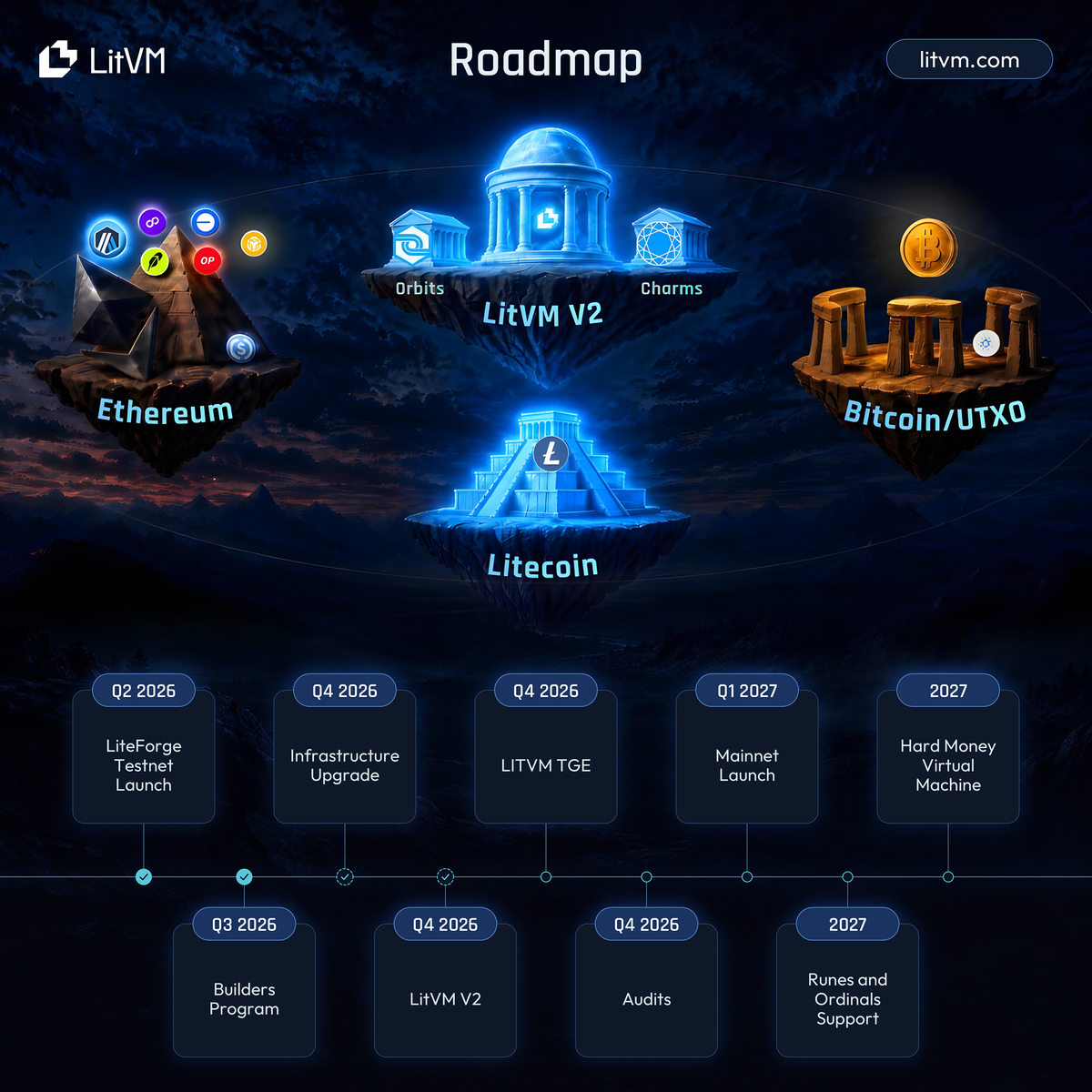

Two Upgrades, One Announcement
V2 consists of two distinct improvements.
The headline is a new bridge architecture, co-developed with the creator of the Charms protocol, that replaces our existing Litecoin-to-LitVM connectivity with something architecturally superior.
The second is a migration of our RaaS (Rollup-as-a-Service) infrastructure to Zeeve, driven directly by the chain activity growth described above.
They’re being announced together because they represent a coherent step-change — not patching the current system, but upgrading the foundations for what comes next.
What Is Charms?
Charms is an open-source protocol for programmable assets across UTXO-based blockchains, built around a single principle: assets should move between chains without bridges, custodians, or centralized intermediaries.
It achieves this through client-side validation and zero-knowledge proofs. Rather than locking assets in a smart contract controlled by a bridge operator, Charms assets are validated locally by the participants in a transaction — backed by ZK proofs that verify the full history of an asset without any central counterparty. The underlying UTXO chain provides base-layer security. The proof handles programmability.
When a Charms asset moves between chains, it isn’t wrapped or bridged in the traditional sense. It’s cryptographically anchored to its origin chain and natively represented on the destination. On Ethereum, it becomes a standard ERC-20. Validity is enforced by math, not by a multisig.
Charms is already live on Bitcoin, with Cardano integration complete. We’re working directly with Ivan (@imikushin), the developer behind Charms, to fund and accelerate the Litecoin and Ethereum integrations — work that benefits the entire Charms ecosystem while building the infrastructure LitVM needs.
Why This Is a Step Change
The Charms architecture isn’t just a technical improvement — it unlocks capabilities that weren’t possible with traditional bridge designs.
Because Charms is a universal asset standard for UTXO chains, the infrastructure being built for Litecoin doesn’t stop at LTC. The same protocol can carry Litecoin Ordinals, LTC20 tokens, and other Litecoin-native assets into the ecosystem. The rails being laid now carry everything that follows.
Beyond Litecoin, Charms has Bitcoin integrated natively, and Cardano — one of crypto’s most engaged communities — is already part of the ecosystem. Through these connections, LitVM gains interoperability pathways into both, with more to follow as the Charms network grows.
This is the longer arc: LitVM as Litecoin’s programmable home — and through Charms, a destination where UTXO assets from across the ecosystem can participate natively in Hard Money Web3 with value flowing back to the Litecoin ecosystem. V2 is where that chapter starts.
Infrastructure Upgrade: Zeeve
The second piece of V2 is a migration to Zeeve — one of the leading RaaS providers for Arbitrum Orbit chains.
The driver is simple: our community outgrew it. LitVM mainnet activity has outpaced our early projections, and the existing infrastructure was showing the strain — RPC latency, indexing delays, explorer lag. We needed a foundation that keeps pace with actual usage.
The underlying technical stack remains unchanged: Arbitrum Nitro/Orbit, with Espresso for sequencer decentralisation and Succinct for ZK settlement in the pipeline. What improves is the operational layer — more RPC nodes, better throughput, and a block explorer that indexes in real time.
For users and developers, this means a faster, more reliable chain. For LitVM, it means infrastructure that scales with today’s activity and what’s ahead.
The Bigger Picture
LitVM V2 isn’t a reinvention — it’s a maturation. The original thesis hasn’t changed. What’s changed is the tools available to build it, and the clarity of vision that comes from watching the community embrace Hard Money Web3.
The Charms integration is built on open foundations. The protocol is open-source, the code MIT-licensed from day one. What we’re co-developing with Ivan doesn’t just serve LitVM — it extends the Charms protocol itself, making Litecoin and Ethereum first-class citizens in infrastructure that Bitcoin and Cardano already benefit from.
We believe Litecoin’s next chapter is cross-chain. Not just one bridge to one chain — a native interoperability layer, rooted in hard money principles, connecting LTC and Litecoin-native assets to Bitcoin, Ethereum, Cardano, and the ecosystems that follow.
LitVM V2 is where that chapter starts.
About LitVM
LitVM is Litecoin’s Virtual Machine, enabling smart contract capabilities and Web3 applications for Litecoin.
Officially endorsed by the Litecoin Foundation, LitVM is committed to fostering a 'hard money Web3’ ecosystem, including Litecoin yield opportunities, real-world assets, AI and more.