
LitVM is combining some of the world’s most cutting-edge blockchain innovations to create a Web3 industry first: a trustless EVM ecosystem tailored specifically to Litecoin’s tech, mission, and vibrant community. For well over a decade, Litecoin has served as one of the most secure, decentralized, and censorship-resistant distributed networks in existence.
Nonetheless, it has remained functionally isolated from the programmability and composability now commonplace in the modern Web3 landscape. LitVM has arrived on the scene to change that. By connecting Litecoin-native value with a high-performance EVM environment, LitVM opens the door for a new wave of yield markets, RWAs, AI-integrated consumer apps, advanced payments, and much more — without changing Litecoin’s underlying consensus or core functions.
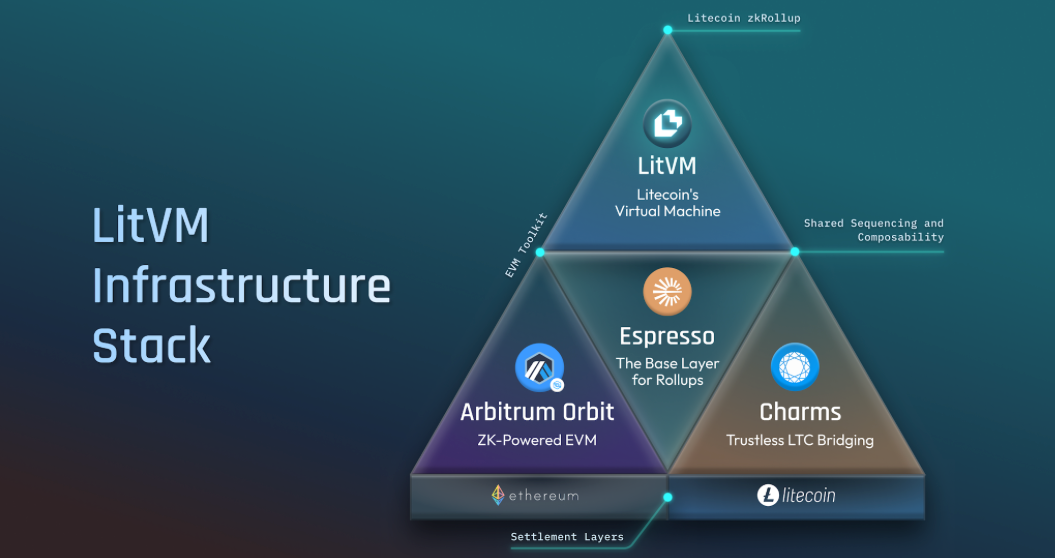
But LitVM isn’t just porting an EVM to Litecoin. It is building a modular, proof-enabled architecture using leading infrastructure from across the industry: Arbitrum Orbit and Nitro for EVM execution, Ethereum for settlement, Succinct for zero-knowledge proving technology, Espresso for sequencing, and Charms Protocol for trustless Litecoin interoperability.
This isn’t your everyday Web3 systems model — it’s the dream-team tech stack that digital silver has been waiting for to make its foray into the mass market. With LitVM, adoption-ready Litecoin Web3 is closer than ever before.

Under the Hood: The LitVM Tech Stack
The LitVM tech stack has been carefully architected to integrate a series of state-of-the-art technical components, each serving a distinct role in expanding what can be built around Litecoin. Already deep into development, LitVM is coming together one game-changing piece at a time.
At a high level, LitVM combines EVM-compatible execution through Arbitrum Orbit and Nitro, Ethereum settlement, zero-knowledge proving technology from Succinct, sequencing infrastructure from Espresso, and Charms-powered interoperability connecting native LTC with the EVM ecosystem.
Without further ado, here’s the breakdown of the core components.
Charms Protocol
Charms Protocol provides the Litecoin interoperability layer at the heart of LitVM’s V2 architecture.
Charms is an open-source protocol for programmable assets across UTXO-based blockchains. It uses client-side validation and zero-knowledge proofs to establish the validity of asset state and state transitions without requiring the underlying blockchain to execute EVM-style application logic.
For LitVM, Charms is being extended to support Litecoin and Ethereum, creating the foundation for native LTC to be represented within the EVM ecosystem as zkLTC. Rather than relying on a conventional custodial bridge operator to attest to asset validity, the Charms architecture uses cryptographic proofs to validate asset state and movement.
The intended route into LitVM is:
Litecoin → Charms / zkLTC → Ethereum → Arbitrum → LitVM
Charms provides the Litecoin ↔ Ethereum interoperability layer, while Arbitrum infrastructure connects Ethereum ↔ LitVM. The LitVM Bridge is intended to abstract these underlying layers into a unified user experience.
Once inside LitVM, zkLTC can be used across DeFi, RWA infrastructure, advanced payments, gaming, AI-integrated applications, and more — bringing entirely new utility to Litecoin and its holders.
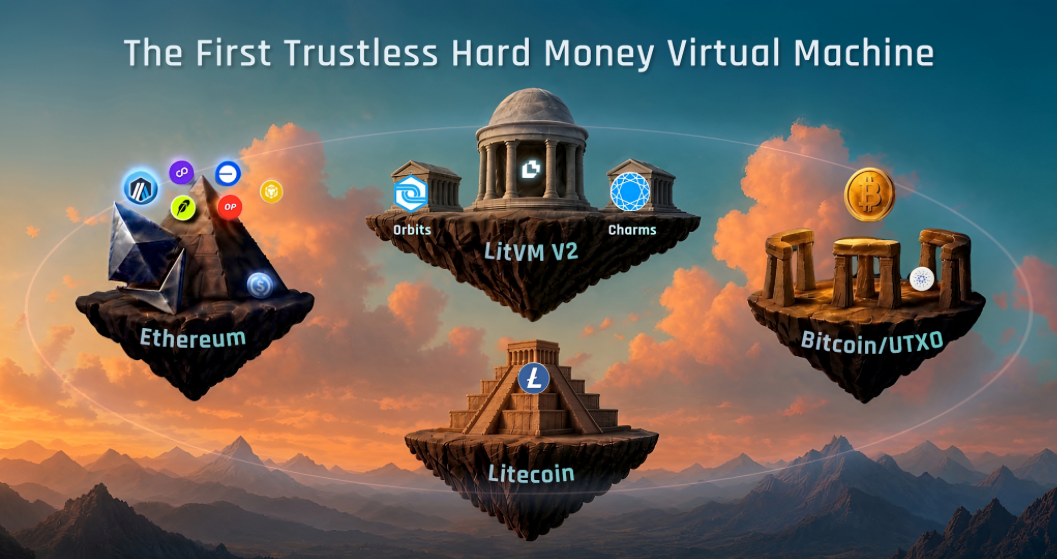
Charms also introduces a broader interoperability opportunity. With support already spanning ecosystems such as Bitcoin and Cardano, future Charms integrations can create pathways for additional hard-money assets and users to enter LitVM, bringing further liquidity and economic activity into the Litecoin ecosystem.
Arbitrum Nitro (+ Succinct zkVM)
LitVM is built as an EVM-compatible Arbitrum Orbit chain, with Arbitrum Nitro providing the high-performance execution environment developers know from the wider Ethereum ecosystem.
Arbitrum Orbit gives LitVM the flexibility to operate as a purpose-built chain for Litecoin while retaining compatibility with familiar Solidity tooling, wallets, libraries, and smart contract infrastructure. Nitro provides the underlying execution technology, enabling scalable transaction processing and low-cost EVM interactions.
Ethereum serves as LitVM’s settlement layer. This role is distinct from Litecoin itself: native LTC remains owned and secured on the Litecoin blockchain, while LitVM execution ultimately settles through Ethereum.
Succinct provides the zkVM technology for LitVM’s proving architecture, adding cryptographic verification capabilities alongside Arbitrum’s rollup infrastructure. This proving system serves a different role from the Charms proof system used for Litecoin asset interoperability: Succinct relates to proving LitVM execution, while Charms validates programmable asset state and cross-chain transitions.
The result is a high-performance EVM-compatible environment designed to combine familiar Ethereum development infrastructure with Litecoin-native value — giving developers the tools to build sophisticated Web3 applications around digital silver.
Espresso
Espresso’s decentralized sequencing infrastructure is designed to strengthen LitVM’s transaction-ordering layer and reduce reliance on a single centralized sequencer.
Through Espresso, LitVM can benefit from distributed transaction sequencing, censorship resistance, improved liveness, and cross-chain coordination. Rather than relying solely on one party to determine transaction inclusion and ordering, shared sequencing infrastructure creates a pathway toward a more resilient and decentralized operating model.
Espresso also contributes to LitVM’s broader interoperability strategy by enabling coordination with other rollups and EVM ecosystems. Together with Charms and Arbitrum infrastructure, this helps position LitVM as a highly connected environment where Litecoin-native value can interact with the wider Web3 economy.
The Road to Mainnet
LitVM’s journey to mainnet is well underway, with the LiteForge testnet providing the environment in which the network, infrastructure, applications, and developer experience can be battle-tested ahead of production launch.
Rather than migrating LitVM toward Litecoin-native settlement, the V2 architecture is designed around a permanent separation of responsibilities: Litecoin secures native LTC, Charms connects Litecoin with the EVM ecosystem, Ethereum provides LitVM settlement, Arbitrum powers EVM execution and the Ethereum ↔ LitVM connection, Succinct provides proving technology, and Espresso provides sequencing infrastructure.
The remaining road to mainnet therefore centers on hardening these integrations, completing the Litecoin interoperability layer, and preparing the ecosystem for production use.
1. Battle-Test the LitVM Execution Environment
Description: Continue testing and hardening LitVM’s Arbitrum-based EVM execution environment under realistic network and application workloads.
Purpose: Validate smart contract compatibility, network stability, transaction execution, developer tooling, gas behavior, and infrastructure before production deployment.
High level: LiteForge provides developers and ecosystem partners with a live environment in which to deploy applications, identify edge cases, and stress-test LitVM before mainnet. The objective is simple: make sure the chain and its developer experience are robust before real economic value is introduced.
2. Proving, Sequencing, and Infrastructure Integration
Description: Continue integrating and validating LitVM’s proving, sequencing, and Rollup-as-a-Service infrastructure.
Purpose: Prepare the components supporting execution verification, transaction ordering, chain operations, and production reliability for mainnet.
High level: LitVM brings together several specialized infrastructure layers rather than asking one component to do everything. Succinct provides zkVM proving technology, Espresso provides sequencing infrastructure, and LitVM’s operational infrastructure supports deployment and network reliability. Before mainnet, these components must operate coherently under production conditions.
3. Charms and zkLTC Integration
Description: Complete the Charms-powered Litecoin ↔ Ethereum interoperability layer and integrate zkLTC into the LitVM environment.
Purpose: Enable native LTC to enter the EVM ecosystem as zkLTC and move onward into LitVM through Arbitrum infrastructure, providing LitVM with its intended native gas asset and a core source of ecosystem liquidity.
High level: Charms is the bridge between Litecoin and the EVM world. LitVM is helping fund and co-develop Litecoin and Ethereum support so that users can move from native LTC on Litecoin into zkLTC on Ethereum and ultimately into LitVM through a unified bridge experience.
The intended route is:
Litecoin → Charms / zkLTC → Ethereum → Arbitrum → LitVM
This architecture creates a trustless pathway for Litecoin-native value to participate in smart contracts and Web3 applications while keeping native LTC itself secured by the Litecoin network.
4. Mainnet Launch
Description: Launch LitVM as a production EVM rollup built for the Litecoin ecosystem.
Purpose: Bring together Arbitrum-based execution, Ethereum settlement, zkLTC as the intended native gas asset, Charms-powered Litecoin interoperability, proving infrastructure, sequencing, and a growing application ecosystem.
High level: At mainnet, LitVM will open the door for real economic activity across DeFi, real-world assets, payments, AI-integrated applications, culture, gaming, and other Web3 use cases built around Litecoin.
The launch will mark the beginning rather than the end of LitVM’s growth. As applications, liquidity, developers, and users arrive, the goal is to build an increasingly deep ecosystem around LTC and zkLTC — while broader Charms connectivity creates opportunities for additional users and value from other hard-money ecosystems to flow into LitVM and strengthen the Litecoin economy.
The Future of Litecoin, on LitVM
If the tech is too much to digest in one read, no sweat. The bottom line is this: Litecoin’s future is gonna be lit — on LitVM, that is.
LitVM isn't just adding a generic smart contract layer to Litecoin. It is creating a programmable environment built specifically around Litecoin and its community, allowing LTC and Litecoin-native value to participate in the applications, liquidity, and composability of the wider EVM economy.
By combining Arbitrum execution, Ethereum settlement, Charms-powered Litecoin interoperability, zero-knowledge proving technology, and decentralized sequencing infrastructure, LitVM gives Litecoin a path into modern Web3 without requiring changes to the Litecoin base chain itself.
And the opportunity reaches further still. As Charms expands connectivity across additional hard-money ecosystems, LitVM can attract new assets, users, and liquidity into a programmable environment centered around Litecoin — strengthening digital silver’s role in an increasingly interconnected Web3 economy.
This isn’t just a roadmap — it’s a journey toward an on-chain revolution for digital silver.
About LitVM
LitVM is Litecoin’s Virtual Machine, enabling smart contract capabilities and Web3 applications for Litecoin.
Officially endorsed by the Litecoin Foundation, LitVM is committed to fostering a 'hard money Web3’ ecosystem, including Litecoin yield opportunities, real-world assets, AI and more.